For cold chain SaaS and supply chain visibility platforms, location tracking is only the starting point. Devices also need to capture shipment conditions reliably, fit operational workflows, and deliver usable data to the platform's own systems.
General-purpose GPS trackers designed primarily for vehicles and devices designed for shipment-level cold chain monitoring often have different priorities. The right choice depends on the tracking unit, environmental monitoring requirements, power source, integration needs, and deployment costs.
AOVX provides 4G smart labels, temperature data loggers, and OEM/ODM hardware development for cold chain and asset tracking projects. This guide explains what platform providers should compare—and what evidence they should request before selecting a hardware partner.
1. Start With the Tracking Unit: Vehicle or Shipment?
Vehicle tracking devices commonly focus on routes, theft prevention, ignition status, vehicle interfaces, and long-term operation. Established vehicle GPS solutions can be a strong fit for these requirements.
Shipment-level visibility raises additional questions:
- Where is the shipment?
- Has it experienced a temperature excursion?
- Has an unexpected opening or light exposure occurred?
- Can the battery cover the journey, including potential delays?
- Can shipping staff deploy the device quickly?
- Can the data flow into the customer's existing platform?
A refrigerated truck may carry shipments belonging to several customers or production batches. Vehicle location and refrigeration-unit data do not fully replace environmental records associated with individual shipments.
Before comparing products, define the monitoring level: vehicle, container, pallet, or package.
2. What Should Platforms Compare?
In this article, "general-purpose GPS suppliers" refers to suppliers primarily serving vehicle tracking and fleet management. Capabilities vary, and some also offer comprehensive cold chain solutions.
| Evaluation area | Common vehicle-tracking priorities | Shipment-level cold chain requirements |
|---|---|---|
| Tracking unit | Vehicles, fleets, and long-life assets | Packages, pallets, shipments, and transport assets |
| Data | Location, routes, speed, and vehicle status | Location plus temperature, humidity, light, or other conditions, depending on the model |
| Power | Vehicle power or periodic charging | Disposable or rechargeable batteries matched to journey duration |
| Deployment | Installation, wiring, and configuration | Fast activation and placement with minimal handling |
| Reliability validation | Vehicle environments and long-term installation | Low temperatures, battery behavior, journey duration, and data completeness |
| Integration | Protocol access and third-party connectivity | Data protocols, offline recovery, configuration, and integration support |
| Cost assessment | Hardware, installation, connectivity, and maintenance | Cost per shipment, deployment labor, and device recovery |
Two products described as "4G trackers" are not necessarily interchangeable. Cellular connectivity and GNSS positioning are also separate capabilities. Depending on the model, a device may use GNSS, Wi-Fi, or cellular positioning; 4G connectivity alone does not establish location accuracy.
3. Temperature Monitoring Requires More Than a Specification
A temperature accuracy claim is useful, but procurement evaluation should also examine how it was tested.
Ask the supplier to identify the test temperatures, reference probe, stabilization period, sampling interval, and acceptance criteria. Records should ideally be linked to device identifiers and hardware and firmware versions.
The AOVX example shown below compares readings from multiple devices against a calibrated reference probe and records their deviations. This format helps assess consistency between units and identify deviations requiring investigation.
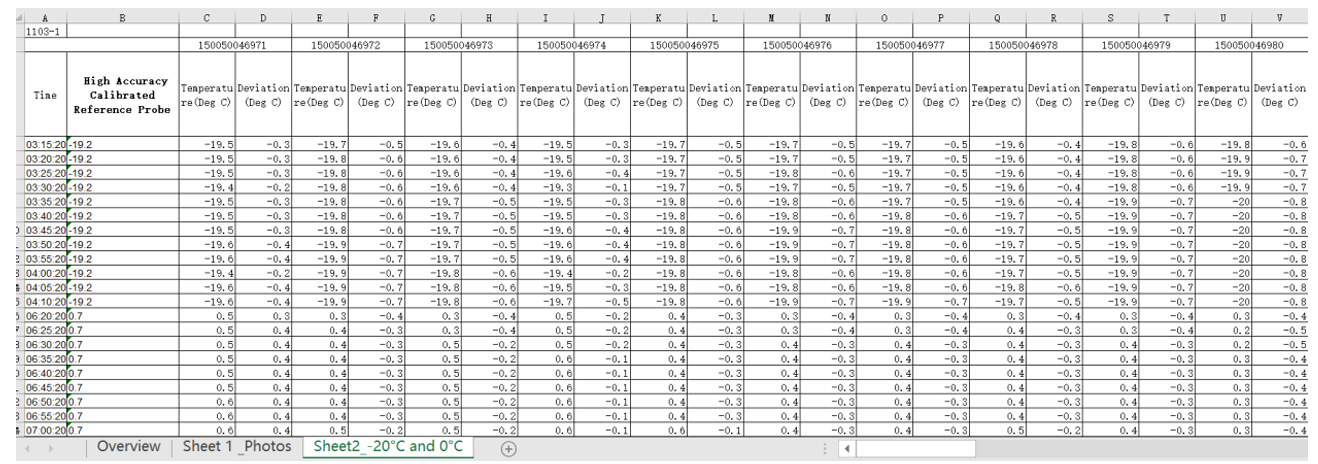
A record should be evaluated against the applicable specification. For example, measurements near −20°C should be assessed using the accuracy requirement for that temperature range, rather than a specification that applies elsewhere.
4. Understand What Low-Temperature Screening Actually Covers
Low temperatures can affect battery performance and electronic components. Cold chain hardware needs validation and production screening appropriate to its intended use.
The example AOVX PCBA low-temperature aging procedure includes:
- Holding the PCBA at −20°C for four hours after SMT assembly.
- Returning it to room temperature for four hours.
- Performing the PCBA test.
- Proceeding with production if the test passes.
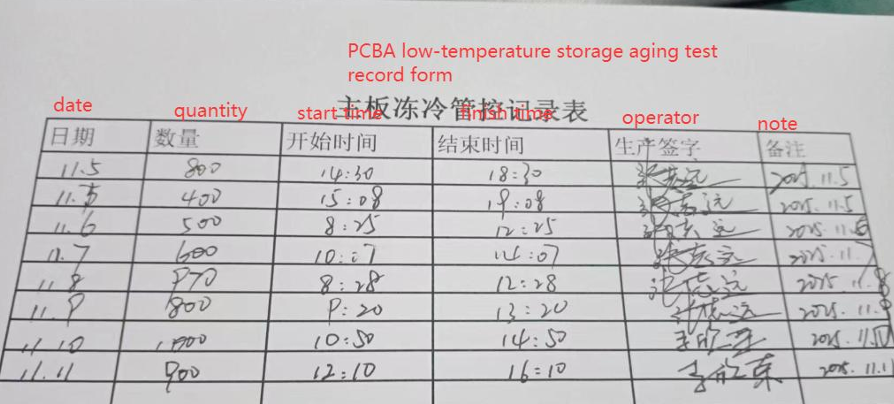
This procedure helps screen for abnormalities following cold exposure that may relate to incoming materials or manufacturing. Because functional testing takes place after recovery to room temperature, it does not independently demonstrate continuous device communication at −20°C.
It also does not replace battery, radio, or complete-device endurance testing under cold conditions. Understanding these boundaries prevents a screening procedure from being mistaken for full validation of a cold chain deployment.
5. Low-Power Design Needs Production Verification
Battery life depends on battery capacity, temperature, signal conditions, positioning method, sampling frequency, reporting intervals, and retry behavior.
Production testing therefore plays an important role in identifying abnormal current consumption.
The example AOVX production log records timestamps, device identifiers, and current readings. The visible entries show approximately 69–77 μA.
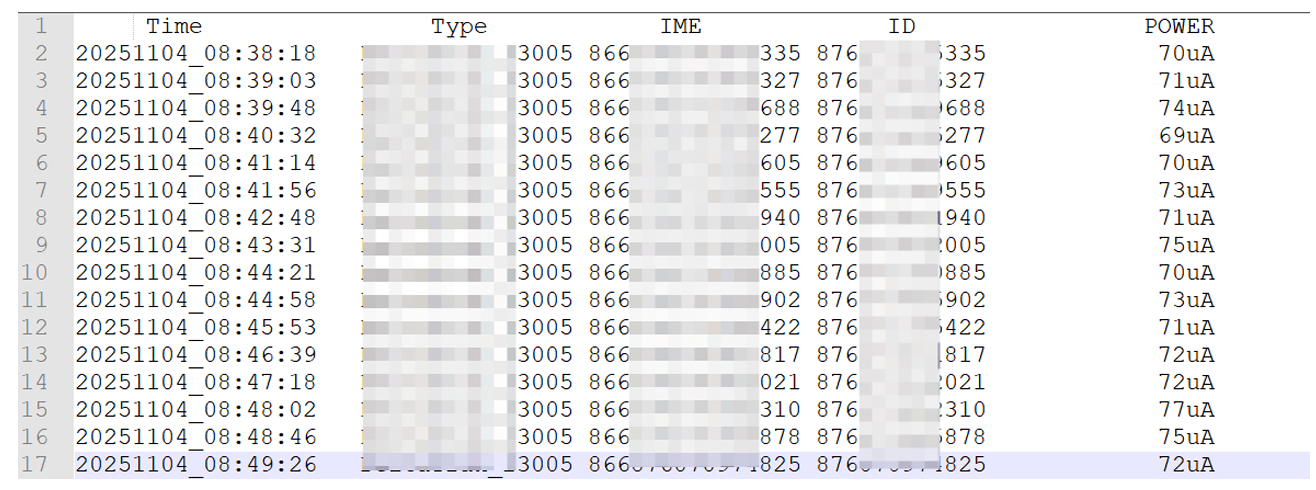
These records demonstrate device-linked current checks. They should not be interpreted as the device's average operating current or used alone to calculate shipment battery life.
A complete endurance assessment must also account for cellular uploads, positioning, network searches, weak-signal retries, and battery performance at low temperatures.
6. Evaluate Platform Integration and OEM/ODM Support
For companies operating their own software, a hardware partnership also needs to support practical integration and manageable product maintenance.
When assessing AOVX or another supplier, clarify the following during sample evaluation:
- Data and protocols: Field definitions, units, timestamps, protocol versions, and example messages.
- Offline behavior: Local storage, data recovery, and duplicate handling after connectivity returns.
- Configuration: Sampling and reporting intervals, alert settings, and applicable remote configuration capabilities.
- Branding and customization: Available label, packaging, firmware, and hardware changes, with associated minimum quantities, costs, and timelines.
- Change management: Notification, validation, and traceability for hardware, firmware, and critical component changes.
- Production readiness: Sample-to-production consistency, outgoing tests, and procedures for resolving failures.
AOVX's approach is to support shipment-level cold chain and asset tracking projects with suitable 4G hardware and OEM/ODM services. Functions, integration arrangements, and customization scope should be confirmed for each model and project.
7. Which Type of Supplier Fits Your Project?
If the main requirements are vehicle theft prevention, ignition monitoring, vehicle interfaces, and continuous vehicle power, start by evaluating established vehicle GPS solutions.
If the project requires shipment temperature monitoring, fast deployment of disposable devices, thin smart labels, or integration into a proprietary visibility platform, evaluate cold chain IoT hardware partners with relevant products and validation capabilities.
Base the decision on sample testing and total deployment cost. Beyond the unit price, consider integration work, deployment labor, connectivity, device recovery, and exception handling.
Frequently Asked Questions
Can a general-purpose GPS tracker monitor cold chain shipments?
Yes, if the specific product provides suitable sensors, power, operating temperature range, and data capabilities. Suitability should be established against project requirements and verified through testing.
Does PCBA low-temperature aging prove complete-device battery life in cold conditions?
No. Screening and endurance testing serve different purposes. Battery life needs testing with the intended battery, operating configuration, and environmental conditions.
Does a low current reading prove long battery life?
No. The operating state must be identified, and the assessment must include uploads, positioning, retries, and battery conditions.
What should a platform provider verify first during sample evaluation?
Verify that required data can reach the platform, then test monitoring performance, deployment workflows, battery life, and data completeness under representative transport conditions.
Discuss Your Tracking Hardware Project With AOVX
If you are evaluating 4G tracking devices for a cold chain SaaS or supply chain visibility platform, share your transport modes, monitoring temperature range, journey duration, data requirements, and expected volumes with AOVX.
We can discuss suitable models, evaluation samples, protocol documentation, and the scope of an OEM/ODM engagement.
Learn more: www.aovx.com
Need hardware for a project like this?
Tell us your deployment scenario and we'll recommend the right device class, connectivity and data setup.
Talk to Our Engineers →